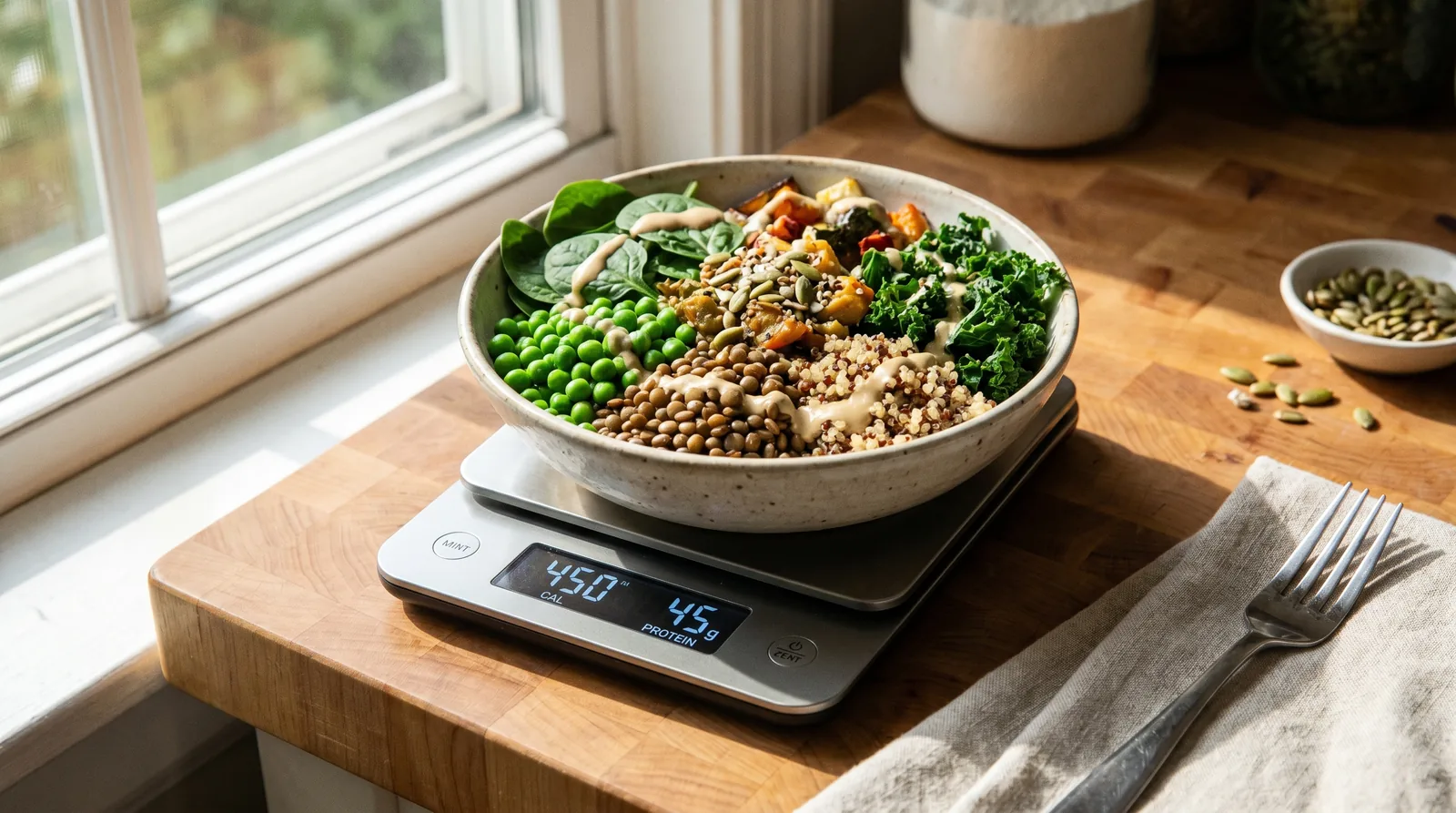
Choosing protein powder for body recomposition comes down to one arithmetic problem: how do you eat enough protein to gain muscle while staying near or slightly below maintenance calories? Recomposition — losing fat and adding lean mass at the same time — requires near-maintenance energy intake, progressive resistance training, and a daily protein intake of roughly 1.6–2.4 g/kg of body weight. Protein is the lever that lets muscle protein synthesis exceed breakdown even when calories are flat.
For body recomposition, aim for 1.6–2.4 g of protein per kg of body weight daily — about 112–168 g for a 70 kg person — spread across at least four meals of 30–40 g each, with roughly 2.5 g of leucine per meal. A protein powder helps you reach that number without adding many calories: at roughly 4 calories per gram of protein, a lean isolate lets you stay in a slight deficit while still hitting your target. Resistance training is non-negotiable; protein alone does not build muscle.
What Body Recomposition Actually Requires
Body recomposition is the simultaneous loss of fat and gain of lean mass. It works because muscle protein synthesis and fat loss are governed by different signals — training and protein drive the first, an energy deficit drives the second. Muscle growth requires muscle protein synthesis (MPS) to exceed muscle protein breakdown (MPB) over time (Phillips et al., 2014, Sports Medicine, PMID:24791918). In a slight deficit, that net-positive balance is harder to reach, which is exactly why protein intake and resistance training carry more weight here than in a surplus.
Three conditions have to hold at once:
- Near-maintenance calories — a small deficit (roughly 10–20% below maintenance) for fat loss, or a small surplus for a slower lean-mass bias.
- Progressive resistance training — consuming protein powder alone does not build muscle; it has to be combined with resistance exercise.
- High protein intake — enough total protein, distributed across the day, with adequate leucine at each meal.
Edward Helms and colleagues (Helms et al., 2014) documented that lean athletes preserve muscle in a deficit far better at the higher end of the protein range, and Murphy et al. (2015) reached a similar conclusion for older adults losing weight. Both point the same direction: when calories drop, protein has to rise.
Daily Protein Targets by Goal
Protein needs scale with your goal, not your weight alone. The table below gives the standard ranges with worked examples for a 70 kg (154 lb) person. Recomposition sits at the high end because you are asking the body to add tissue without an energy surplus to make it easy.
| Goal | Protein (g/kg/day) | Example: 70 kg person |
|---|---|---|
| Maintenance / sedentary | 0.8 | 56 g |
| Fat loss (cut) | 1.2–1.6 | 84–112 g |
| Body recomposition | 1.6–2.4 | 112–168 g |
| Lean bulk | 1.6–2.2 | 112–154 g |
The 0.8 g/kg figure is the RDA — the minimum to avoid deficiency, not the amount that supports muscle gain. If you are reading labels and counting grams, you already sit above it. For the full case on protein intake while in a deficit, see our guide to protein for weight loss.
Why Protein Distribution Matters More in a Recomp
In a recomposition, how you spread protein matters more than it does in a surplus. Each meal needs roughly 30–40 g of protein carrying at least 2.5 g of leucine to trip the muscle protein synthesis switch; eating four-plus meals at that level keeps synthesis elevated across the day rather than in one large spike. Total daily protein still sets the ceiling, but distribution determines how much of it you convert into muscle.
Leucine is the trigger amino acid. Plant proteins generally induce a lower and slower postprandial rise in essential amino acids and leucine than whey, which is why per-meal dose and leucine content deserve attention when you build your day around a plant source. A practical structure for a 70 kg person targeting 140 g:
- Breakfast: 35 g
- Lunch: 35 g
- Post-training or afternoon: 35 g
- Dinner: 35 g
A protein shake covers the meals where whole food falls short — typically breakfast and the post-training slot. For the mechanics of recovery feeding, see what to eat after training.
Calorie Efficiency: Why Per-Gram Cost Matters
The defining constraint of a recomp is the calorie budget. This is where a lean isolate earns its place. Potato protein isolate delivers roughly 4 calories per gram of protein, versus about 5.2 for many whey concentrates carrying residual lactose and fat. More protein per calorie means you can hit 140 g of protein while staying inside a slight deficit — the difference between a target you can sustain and one that pushes you over maintenance.
The math compounds. Hitting 140 g of protein from a source at 4 cal/g costs about 560 calories; at 5.2 cal/g it costs about 728. That 168-calorie gap, repeated daily, is the entire margin of a modest deficit. Whey protein isolate itself is 90–95% protein and under 1% lactose, so the leanest whey is comparable — the penalty lives mostly in cheaper concentrates. For low-calorie shake construction, see our low-calorie protein shake guide.
Does Potato Protein Build Muscle?
Yes. A 2020 study found that 25 g of potato protein isolate taken twice daily stimulated muscle protein synthesis at rest and during recovery from resistance exercise in young women, supporting its classification as a high-quality plant protein (Nutrients, 2020, PMID:32349353). That is a meaningful result: it shows a single-ingredient plant isolate can drive the synthesis response a recomp depends on.
Whey still has an edge in head-to-head MPS trials thanks to faster digestion and higher leucine — in one controlled trial, 30 g of whey raised myofibrillar protein synthesis above placebo after exercise, while a matched dose of collagen did not reach a significant rise over placebo (Med Sci Sports Exerc, 2023, PMID:37202878). We will not pretend otherwise. The practical answer is to dose plant protein slightly higher per meal and keep total daily intake at the upper end of the recomposition range. For the underlying scoring system, read PDCAAS explained, and for the ingredient itself, what is potato protein.
Training Timing: When to Take It
Pre-workout protein is not required for body recomposition; the post-workout window is wide, roughly 30–120 minutes after training. Total daily protein and per-meal distribution matter far more than precise timing around a session. If your last meal contained 30–40 g of protein within a few hours of training, the so-called anabolic window is already covered.
The honest version: timing is the smallest variable in the equation. Get total grams right, spread them across four meals, train with progressive overload, and the post-workout shake becomes a convenience rather than a requirement.
Is High Protein Safe?
For healthy adults, intakes well above the RDA show no adverse effect on kidney function. A 2018 systematic review of 28 trials and 1,358 participants found that glomerular filtration rate did not differ between higher- and lower-protein diets in healthy adults (Devries et al., The Journal of Nutrition, 2018, PMID:30383278). A one-year crossover study in resistance-trained men eating 2.51–3.32 g/kg/day found no harm to blood lipids, liver, or kidney markers (Journal of Nutrition and Metabolism, 2016, PMID:27807480). High protein also increases satiety and thermogenesis more than standard-protein meals (Journal of the American College of Nutrition, 2004, PMID:15466943) — useful when you are eating at a deficit.
One contamination caveat: the Clean Label Project’s 2025 Protein Study 2.0 tested 160 products and found 47% exceeded at least one safety standard, with plant-based powders averaging five times more cadmium than whey. Single-ingredient sourcing and third-party testing matter.