Potato protein isolate is not pressed out of potatoes you would eat. It is recovered from potato fruit juice, the watery liquid left over after starch is extracted during industrial potato processing. That juice was historically treated as a waste stream; the protein dissolved in it is now concentrated and dried into a powder that runs 80–95% protein on a dry basis.
Potato protein isolate is produced from potato fruit juice (PFJ), the byproduct left after starch is washed out of potatoes during starch manufacturing. The dissolved protein is recovered by methods such as expanded bed adsorption or ultrafiltration, then dried into a powder containing 80–95% protein. Commercial isolates such as Solanic typically test above 90% protein on a dry basis.
This article covers production and specification only — how the isolate is extracted, fractionated, dried, and purified, and how an isolate differs from a concentrate. For the broader question of what the ingredient is and how it compares nutritionally, start with our pillar guide, What Is Potato Protein?
| Stage | Material | Approximate protein content |
|---|---|---|
| Whole potato (cooked, eaten) | Tuber, 148 g serving | 3 g protein per serving |
| Starch extraction | Potato fruit juice (byproduct) | 1–2% protein in solution |
| Concentrate | Recovered, partially purified | ~70–85% protein (dry basis) |
| Isolate | Further purified, dried | 80–95% protein (dry basis) |
Where Potato Protein Isolate Comes From
Potato protein isolate begins as a coproduct of starch production. When potatoes are processed for starch, the cells are ruptured and washed, and the starch granules are recovered. Wet-isolation starch recovery rates from potatoes range from 61–67% (Food Research International, 1999). What remains is potato fruit juice — also called potato fruit water (PFW) — a liquid containing roughly 1–2% dissolved protein along with sugars, minerals, and other soluble compounds.
That juice was for decades considered a disposal problem. A patent filing by Cooperative Avebe describes potato fruit water as “a waste stream from the production of potato starch or from the processing of consumption potatoes” (Patent WO2014011042A1, 2014). The shift from waste stream to ingredient is the entire reason potato protein isolate exists at commodity scale. A standard 148 g potato serving carries about 3 g of protein (Potatoes USA), so the protein has to be drawn out of large volumes of juice and concentrated heavily to reach a usable powder.
How Is Potato Protein Made, Step by Step?
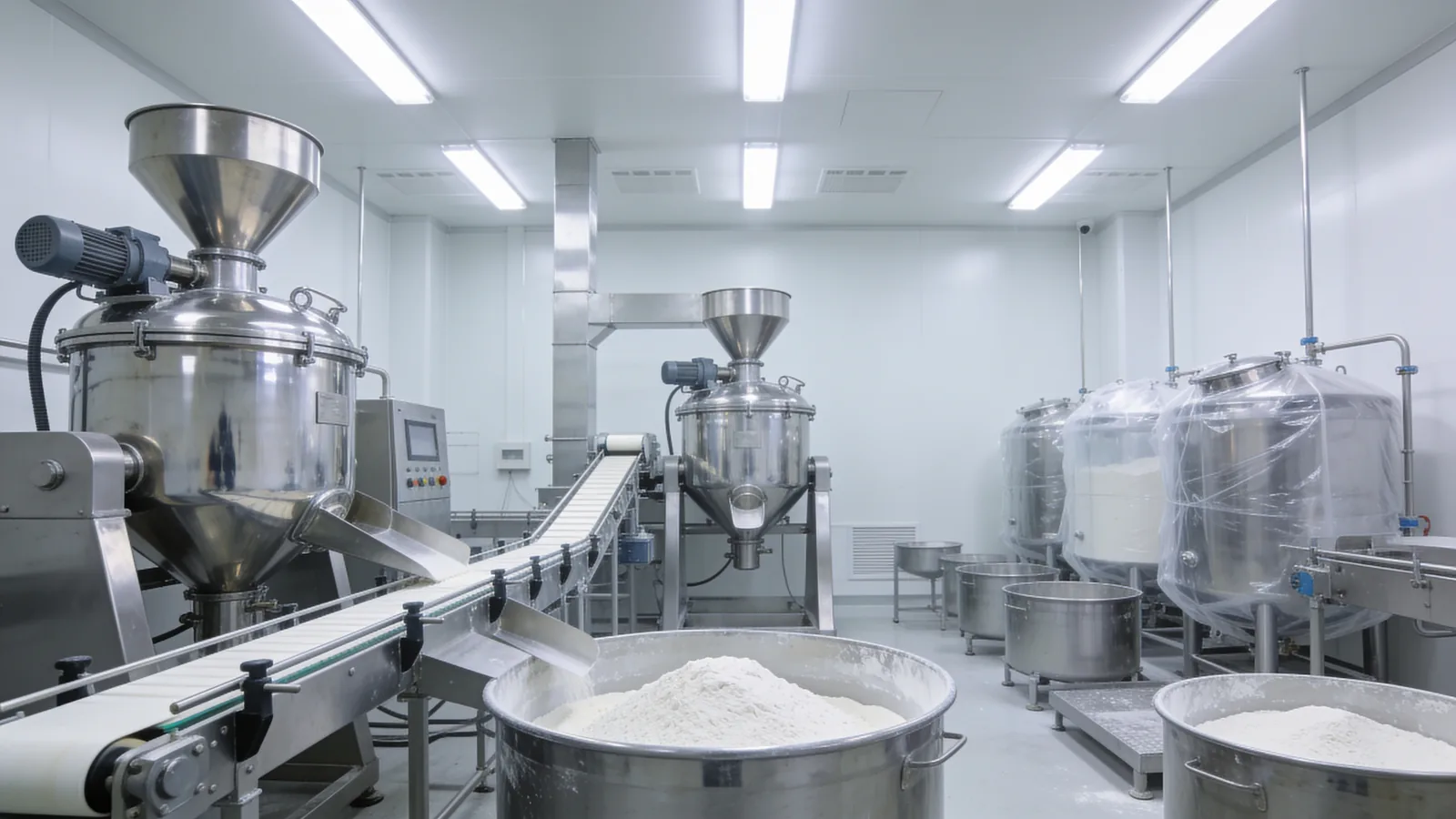
Potato protein is made by recovering the soluble protein from potato fruit juice, concentrating it, and drying it into powder. The protein is captured using methods such as expanded bed adsorption (EBA) or ultrafiltration (UF), which separate intact protein from the surrounding sugars and salts (Food and Bioprocess Technology, 2012). The recovered fraction is then dried.
The sequence, in order:
- Starch removal. Potatoes are rasped and washed; starch is recovered, leaving potato fruit juice behind.
- Clarification. Fibers and cellular debris are screened and separated from the juice.
- Protein recovery. The dissolved protein is captured. Historically this was done by heat-acid coagulation, which denatures the protein and yields a feed-grade material. Recovery of native protein for food use has been attempted with expanded bed adsorption and ultrafiltration (Food and Bioprocess Technology, 2012), and by precipitation with ethanol or ferric chloride (PMID:19739640).
- Washing and purification. The recovered fraction is washed to remove residual sugars, salts, and unwanted soluble compounds.
- Drying. The concentrate is spray-dried into a fine powder.
The recovery method matters because it determines whether the finished protein is denatured or kept closer to its native, soluble form. Potato proteins are soluble at neutral and strongly acidic pH values (Journal of Agricultural and Food Chemistry, 2001, PMID:11600040), which gives manufacturers a window to recover them gently rather than cooking them out of solution.
Wet Fractionation and Drying in Potato Protein Manufacturing
Potato protein manufacturing is a wet-fractionation process — the protein is separated while still dissolved in liquid, not milled from a dry solid. This distinguishes it from flour-based ingredients, where the whole tuber is dried and ground. Wet fractionation lets the protein be isolated away from starch, fiber, and sugars before any drying step, which is how the protein content climbs from a couple of percent in the juice to above 80% in the finished powder.
Two protein families dominate the recovered fraction: patatin, a storage protein that makes up the bulk of the soluble protein, and protease inhibitors, smaller proteins that account for much of the remainder. Many commercial isolates are described as patatin-rich because patatin survives gentle recovery well and carries strong functional properties. The drying method — typically spray drying — sets the final particle size and solubility. Gentle, low-heat drying preserves the protein’s native structure; aggressive heat denatures it, which can change how it dissolves and behaves in food.
Functionality is the reason food formulators care about the recovery and drying conditions. Where the protein is kept soluble, it disperses cleanly and adds little flavor of its own. It disappears into your food. That neutrality is a processing outcome, not a marketing claim — it depends on how carefully the protein was handled before it reached the bag.
Isolate vs Concentrate: What the Protein Percentage Means
The difference between an isolate and a concentrate is the degree of purification, expressed as protein percentage on a dry basis. A concentrate carries more of the non-protein material — residual carbohydrate, minerals, and other solubles — while an isolate has been processed further to strip most of that away. Commercial potato protein isolates such as Solanic test above 90% protein (Agricultural Utilization Research Institute, 2018), and “Potato Protein Isolate 90%” is a commonly listed product specification.
The same logic governs dairy proteins, which makes them a useful reference point. Whey protein isolate is 90–95% protein with less than 1% lactose, while whey concentrate is lower in protein and higher in carbohydrate. Monash University notes that whey isolates undergo more extensive processing so the final product is higher in protein, while concentrates retain more lactose. For someone reading a label, the practical translation is simple: an isolate gives you more protein and fewer of the residual compounds per gram. For an extracted ingredient, that is the point of buying an isolate at all.
Higher protein percentage does not automatically mean better protein quality — those are separate measurements. Potato protein isolate has a PDCAAS in the range of 0.92–1.00 and a reported DIAAS as high as 100% (Food Science & Nutrition, 2020, PMID:33133540), regardless of whether it is sold as a concentrate or an isolate. The percentage tells you how concentrated the protein is; the amino acid scores tell you how complete and digestible it is. We break the quality side down further in our guide to protein digestibility.
Purity: Removing Protease Inhibitors and Glycoalkaloids
Potato fruit juice contains two classes of anti-nutrients that a well-made isolate addresses: protease inhibitors, which can interfere with protein digestion, and glycoalkaloids, the bitter, naturally occurring compounds (chiefly solanine and chaconine) that potatoes produce as a defense. Processing reduces both, but neither is eliminated to zero.
Glycoalkaloids are the more closely watched of the two. A 2024 analysis found that commercial potato protein isolates contain trace amounts of glycoalkaloids (Food Chemistry, 2025, PMID:40627963). The concern is not theoretical: feeding salmon a potato protein product with high glycoalkaloid levels caused weight loss in the fish, which is why removal steps exist. Enzymatic hydrolysis methods used to strip glycoalkaloids do not remove the aglycon, which also binds to potato proteins — meaning some processing routes leave residue that simpler assays miss. This is the reason a certificate of analysis matters for an extracted plant protein.
Protease inhibitors are reduced both by purification and by any heat the protein sees during recovery, since they are heat-sensitive. The trade-off is the one described above: heat that deactivates protease inhibitors can also denature patatin and change the powder’s solubility. Manufacturers balance those goals differently, which is part of why isolates from different suppliers behave differently in the same recipe.
Does Processing Affect Whether It Works?
No — a properly made potato protein isolate retains its muscle-supporting properties despite processing. In a 2020 trial, 25 g of potato protein isolate consumed twice daily increased muscle protein synthesis rates at rest and during recovery from resistance exercise in young women (Nutrients, 2020, PMID:32349353). The isolate used was a commercial product, Solanic®100F.
That result is worth stating plainly because skeptics assume an extracted, industrially processed plant protein must be nutritionally degraded. The McMaster University study found the opposite: the isolate behaved as a high-quality protein source capable of stimulating muscle protein synthesis. Recovery and drying concentrate the protein and remove anti-nutrients; done well, they do not strip the amino acids that make the protein useful. If you want the application side rather than the production side, see our guide to protein for athletes.