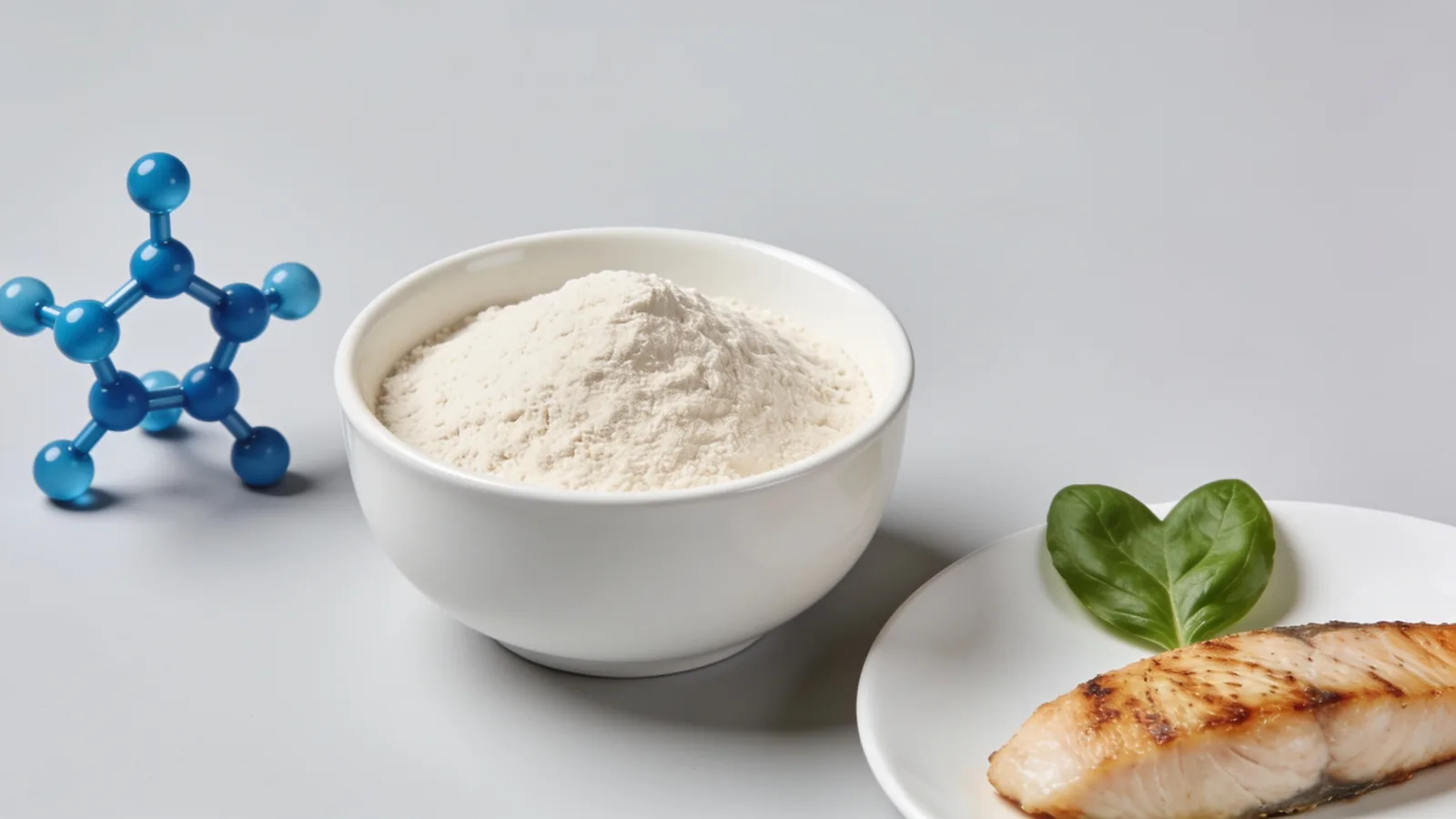
The honest answer depends on which form you mean. A whole potato is not a meaningful protein source — it is mostly water and starch, with only a small fraction of its weight as protein. Potato protein content is a different conversation once the protein is extracted: potato protein isolate runs 80 to 95 percent protein on a dry basis, with a PDCAAS of 0.92 to 1.00 and all nine essential amino acids.
A whole potato is not a good source of protein by quantity — most of its weight is water and starch. But potato protein isolate, extracted from potatoes, contains 80 to 95 percent protein with a PDCAAS of roughly 0.92 to 1.00, putting it on par with several animal proteins. It is also complete, allergy-free, and low-FODMAP.
So the same vegetable produces two very different answers. The starchy thing you bake is a carbohydrate food that happens to contain some protein. The isolate is one of the higher-quality plant proteins available. Most articles blur the two together. Below is the distinction, with the numbers behind it. For the broader background, see our guide on what potato protein actually is.
How Potato Protein Compares to Other Sources
Protein quality is measured two ways: PDCAAS (Protein Digestibility Corrected Amino Acid Score) and the newer DIAAS. Both reward proteins that are easy to digest and carry a full set of essential amino acids. Animal proteins generally score higher than plant proteins, but potato protein isolate is one of the exceptions that closes the gap.
| Protein source | Protein content | Quality score | Complete? | Allergen status |
|---|---|---|---|---|
| Potato protein isolate | 80–95% | PDCAAS 0.92–1.00; DIAAS up to 100 | Yes — all 9 EAAs | Allergy-free; low-FODMAP |
| Whey protein isolate | 90–95% | DIAAS 94–100% | Yes | Dairy |
| Soy protein isolate | — | DIAAS ≥100 | Yes | Soy |
| Egg (whole) | — | PDCAAS 1.00 | Yes | Egg |
| Wheat gluten | — | PDCAAS ~0.25 | No | Gluten |
| Collagen | — | Incomplete (no tryptophan) | No | Bovine/marine |
The egg PDCAAS of 1.00 and wheat gluten figure of roughly 0.25 are established FAO/WHO PDCAAS reference values for those proteins. Collagen, despite being marketed as a protein, lacks tryptophan entirely — one analyzed sample measured 0.00 g per 100 g — which makes it an incomplete source (Paul et al., Nutrients, 2019; PMID:31096622). Potato protein isolate, by contrast, contains all nine essential amino acids. For the full method, see our breakdown of how PDCAAS works.
Are Potatoes a Good Source of Protein?
No — a whole potato is not a good source of protein. It is a starch-dense vegetable that is mostly water, and protein makes up only a small share of its weight. Potatoes do contribute potassium, fiber, and vitamin C, and the protein they contain is high quality, but the total amount per potato is low.
A 2013 roundtable summary noted that potatoes and other white vegetables are meaningful sources of shortfall nutrients such as fiber, potassium, and magnesium (PubMed, 2013; PMID:23674800). Quality and quantity are separate questions, though. The protein in a potato is good; there just is not much of it. Cooking helps digestibility — protein digestibility of potato flour is significantly higher than that of raw potatoes (PubMed, 1998; PMID:9839814) — but it does not add protein that was never there.
Potato Protein Content: Whole Potato vs Isolate
The reason the isolate exists is industrial. Potato protein is extracted from potato fruit juice (also called potato fruit water), a byproduct of starch production (Food and Bioprocess Technology, 2012). That liquid stream was historically treated as waste; separating and drying the protein out of it produces a powder that is 80 to 95 percent protein. Commercial specifications such as “Potato Protein Isolate 90%” are standard, and named ingredients like Solanic exceed 90 percent purity (AURI report, Kleba and Ismail, 2018).
So when someone asks about “potato protein content,” the honest answer is that it ranges across two orders of magnitude depending on form: trace amounts in a baked potato, versus a near-isolated ingredient in a tub of isolate. The starch and the protein come apart during processing; what you buy as potato protein has had the starch removed.
How Good Is Potato Protein Quality?
Potato protein quality is high for a plant source. Its PDCAAS sits among the highest of any vegetable protein, and its DIAAS has been reported as high as 100%, comparable to whey isolate. The main difference from animal protein is a slightly lower essential amino acid fraction.
Potato protein isolate contains 37 percent essential amino acids, versus 43 percent for whey protein isolate (Amino Acids, 2018; PMID:30167963). That gap is real but modest. On DIAAS, both soy and potato isolates reach 100 for children and adults, while whey isolate lands at 94 to 100 — meaning the three are close enough that protein quality is rarely the deciding factor between them. The DIAAS figure of up to 100 for potato protein is documented by Herreman et al. (Food Science & Nutrition, 2020; PMID:33133540).
One measured difference: in an acute crossover study, whey produced a larger insulin and glycaemic response than potato protein, while the plant proteins showed a lower insulinaemic response and better glucose maintenance, with no significant difference in appetite (Nutrients, 2021; PMID:34201703). That is a metabolic-response difference, not a quality defect. If you want the full head-to-head, read potato protein vs whey.
Does Potato Protein Build Muscle?
Yes — potato protein isolate stimulates muscle protein synthesis. In a controlled trial, 25 g of potato protein isolate taken twice daily increased muscle protein synthesis rates at rest and during recovery from exercise in young women, while the placebo group showed no such increase.
That study, led by Stuart Phillips at McMaster University, was published in Nutrients in 2020 (PMID:32349353). The researchers concluded that potato protein isolate is a high-quality plant-based source capable of stimulating muscle protein synthesis effectively. A related line of work from Luc van Loon’s group compared potato protein to milk protein for muscle synthesis at rest and during exercise recovery (Medicine & Science in Sports & Exercise, 2022; PMID:35438672).
It is worth being honest about the asymmetry in the literature. Whey’s rapid digestion and high leucine content make it especially effective at stimulating muscle protein accretion, more so than casein or soy in some trials (American Journal of Clinical Nutrition, 2011; PMID:21367943). Plant proteins, as a class, tend to carry less leucine. Potato protein’s strength is that it performs near the top of the plant category while remaining allergy-free. For application, see our notes on protein for muscle recovery and protein after 40.
Is Potato Protein Safe and Allergy-Friendly?
Potato protein is Generally Recognized As Safe (GRAS) by the FDA, is widely described as an allergy-free protein source, and is classified low-FODMAP by Monash University (2019). It does not contain dairy, egg, soy, nuts, or gluten, which is why single-ingredient potato protein appeals to allergy-aware households.
The one clear exception: a potato allergy. The Center for Research on Ingredient Safety at Michigan State University states plainly that if you have a potato allergy, you should not consume potato protein, because the allergen is still present. In a murine model, patatin and a 53 kDa protein were identified as the main potato allergens (Molecular Immunology, 2018; PMID:30031281). Potato allergy is uncommon, but it exists, and we would rather say so. If allergen avoidance is your priority, our allergen-free protein guide covers the trade-offs across every common source.