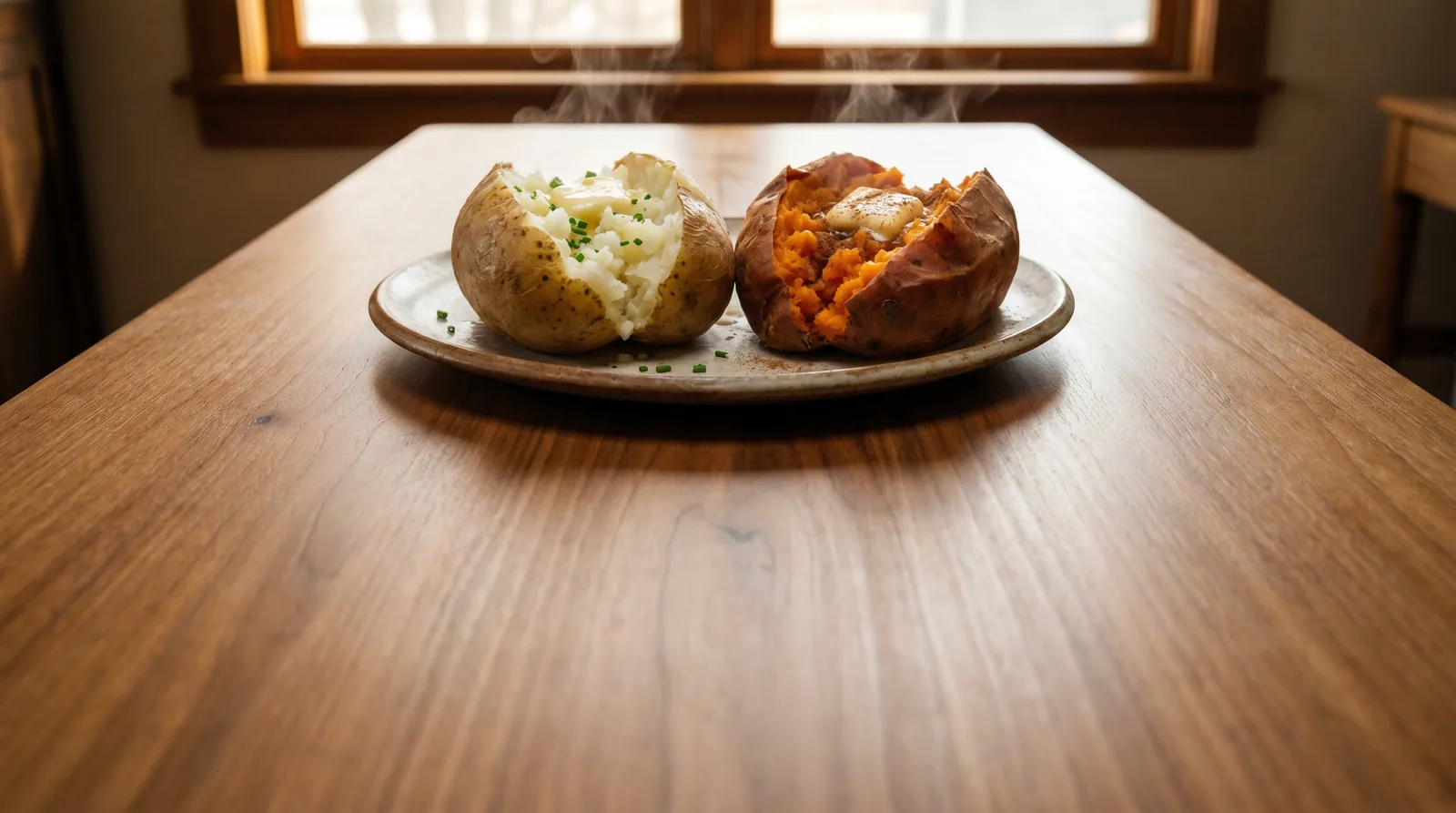
Bodybuilders eat potatoes and sweet potatoes mainly as a carbohydrate source, but baked potato protein is more interesting than its small numbers suggest. A whole potato carries only a few grams of protein, yet that protein is unusually complete — potato protein isolate scores 0.92–1.00 on the PDCAAS scale, on par with several animal proteins. The starch, not the protein, is the reason it shows up on so many meal-prep plates.
Bodybuilders eat potatoes and sweet potatoes primarily as a carbohydrate source to replenish muscle glycogen after training, not for protein. A baked potato supplies only a small amount of protein, but that protein is high quality — potato protein isolate scores 0.92–1.00 on PDCAAS, comparable to several animal proteins and far above wheat gluten at roughly 0.25. The carbohydrate is what supports repeated hard sessions; the protein is a bonus.
Why Do Bodybuilders Eat Potatoes and Sweet Potatoes?
Bodybuilders eat potatoes and sweet potatoes for carbohydrate that replenishes muscle glycogen between training sessions. Both are dense, filling, inexpensive, and easy to portion for a meal-prep schedule. The protein content is secondary — what matters to a lifter is steady carbohydrate that supports repeated hard training without relying on heavily processed foods.
The appeal is practical. A potato is one ingredient. It bakes in bulk, reheats without falling apart, and pairs with a separate protein source — chicken, fish, eggs, or a protein powder — to round out a meal. For anyone tracking macros, a baked potato or sweet potato is a known quantity that does not hide carbohydrate behind a long label. That same single-ingredient logic is what makes potato protein isolate appealing on its own.
Carbohydrate timing is the other reason. Lifters often place starchy carbohydrate around training to restore glycogen for the next session. Potatoes and sweet potatoes digest more slowly than refined sugar, which suits athletes who want sustained energy for training rather than a sharp spike. None of this is unique to bodybuilding — it is just standard sports nutrition applied to a cheap, single-ingredient food.
How Much Protein Is in a Baked Potato?
A baked potato contains only a small amount of protein — it is a starchy food, not a protein food. What makes baked potato protein notable is quality, not quantity. The protein fraction contains all nine essential amino acids and, in isolated form, scores at the top of the plant-protein range on standard quality metrics.
This is the distinction that trips people up. “Protein in a potato” is a tiny number, but the protein that is there is well balanced. Potato protein isolate contains all nine essential amino acids, and reviews consistently rank it among the highest-quality vegetable proteins. So a baked potato will not meet your daily protein target on its own — you still need a dedicated protein source — but the protein it does contribute is not filler.
If you want to dig into the sweet-potato side of this question specifically, we cover the per-serving numbers in how much protein is in a sweet potato.
Potatoes vs Sweet Potatoes: What’s the Difference?
Potatoes and sweet potatoes are not closely related plants, despite the shared name. The white potato (Solanum tuberosum) and the sweet potato (Ipomoea batatas) come from different botanical families. For a lifter, the practical differences are flavor, fiber, and micronutrient profile rather than a meaningful gap in protein.
Sweet potatoes bring more natural sweetness and a different carbohydrate texture; white potatoes are more neutral and pair with savory meals. Both are heat-stable, both reheat well, and both serve the same role on a meal-prep plan: the carbohydrate component you build the rest of the meal around. Choose based on taste and how the rest of your day is structured, not on a belief that one is dramatically higher in protein.
How Good Is Potato Protein Quality?
Potato protein quality is high for a plant source. Potato protein isolate has a PDCAAS of 0.92–1.00, placing it on par with several animal proteins, and its DIAAS has been reported as high as 100%. Plant proteins as a category usually score lower than animal proteins, which is what makes potato protein an outlier worth understanding.
PDCAAS (Protein Digestibility-Corrected Amino Acid Score) measures how well a protein’s amino acids match human requirements after accounting for digestibility. On that scale, egg protein scores 1.00 and wheat gluten scores roughly 0.25 (Schaafsma, Journal of Nutrition, 2000). Potato protein isolate sits near the top of the plant range. The DIAAS for potato protein isolate has been reported as high as 100% (Herreman et al., Food Science & Nutrition, 2020), and reported figures put soy and potato isolates at DIAAS ≥100% for children and adults — comparable to whey isolate at roughly 94–100%.
The table below compares protein sources by digestibility-corrected score and a few practical factors that matter when you are choosing what goes on the plate next to the potato. For more on how these scores are calculated, see our PDCAAS explainer.
| Protein source | PDCAAS | All 9 EAAs? | Common allergen? |
|---|---|---|---|
| Potato protein isolate | 0.92–1.00 | Yes | No (potato is a rare allergen) |
| Egg protein | 1.00 | Yes | Yes (egg) |
| Whey protein isolate | — | Yes | Yes (milk) |
| Wheat gluten | ~0.25 | No | Yes (wheat) |
Reliable single PDCAAS figures vary by lab and reference pattern, so the whey isolate cell is left without a fixed value rather than borrowing one. What the comparison shows clearly: potato protein isolate is one of the few plant proteins that competes with animal proteins on amino acid completeness.
Does Potato Protein Build Muscle?
Potato protein can stimulate muscle protein synthesis. In a controlled trial, 25 g of potato protein isolate consumed twice daily increased muscle protein synthesis rates in young women, while a placebo group showed no increase (Nutrients, 2020, PMID:32349353). That study used an isolate, not whole baked potatoes, which is the important caveat.
The McMaster University research led by Stuart Phillips concluded that potato protein isolate is a high-quality plant protein capable of stimulating muscle protein synthesis at rest and after resistance exercise. Separately, in cell-culture work, a potato protein hydrolysate (PPH902) increased myogenic differentiation and markers associated with muscle protein synthesis (PMID:34770984), suggesting a direct anabolic signal through pathways involving mTOR.
There is one honest trade-off. Plant proteins, including potato, tend to carry less leucine and fewer total essential amino acids than whey — potato protein is about 37% essential amino acids versus roughly 43% for whey isolate (Amino Acids, 2018, PMID:30167963). Whey’s rapid digestion and high leucine content make it a strong stimulus for muscle protein accretion (American Journal of Clinical Nutrition, 2011, PMID:21367943). The practical workaround is straightforward: a slightly larger serving of potato protein closes the gap. For the broader picture of how this applies to lifters, our protein for athletes guide walks through dosing and timing.
What About Sweet Potato and Muscle?
Sweet potato is studied mostly for its carbohydrate and bioactive compounds, not as a protein source. Early preclinical work is suggestive but not conclusive for humans. In a mouse study, a sweet potato extract reduced muscle atrophy by activating the PI3K/Akt pathway, the upstream signaling cascade that leads to mTORC1 activation (PMID:41485211).
Read that in context: it is an animal study using a concentrated extract, not evidence that eating baked sweet potatoes builds muscle directly. For a bodybuilder, the sweet potato’s job remains carbohydrate and micronutrients. The muscle-building stimulus still comes from training plus an adequate, high-quality protein intake spread across the day.
From Whole Potato to Potato Protein Isolate
Potato protein isolate is concentrated from the liquid left over after starch production. Potato proteins are extracted from potato fruit juice — a byproduct stream — and dried into a powder that can be 80–95% protein on a dry basis. This is how the small protein fraction inside a potato becomes a usable protein supplement.
The same protein that contributes a few grams to a baked potato becomes the entire product once the starch and water are removed. It is also a low-FODMAP protein source (Monash University, 2019), which makes it easier on sensitive stomachs than some dairy- or legume-based powders. One ingredient, no additives required — which is the whole idea. You should never have to squint to read your protein label. If you want the full breakdown of how the powder is made and used, see our guide to what potato protein is.
References
- Oikawa et al. Potato Protein Isolate Stimulates Muscle Protein Synthesis at Rest and with Resistance Exercise in Young Women. Nutrients, 2020. PMID:32349353.
- Schaafsma G. The Protein Digestibility-Corrected Amino Acid Score. Journal of Nutrition, 2000. PMID:10867064.
- Herreman et al. Food Science & Nutrition, 2020. PMID:33133540.
- Amino Acids, 2018. PMID:30167963.
- Whey protein stimulates postprandial muscle protein accretion more effectively than do casein and casein hydrolysate in older men. American Journal of Clinical Nutrition, 2011. PMID:21367943.
- Alcalase Potato Protein Hydrolysate-PPH902 Improves Myogenic Differentiation and Skeletal Muscle Protein Synthesis under High Glucose Condition in C2C12 Cells. 2021. PMID:34770984.
- Extract of Aerial Parts of “Tongchaeru” Sweet Potato Attenuates Muscle Atrophy via Mitochondrial Improvement and PI3K-Akt Pathway Activation. J Food Sci, 2026. PMID:41485211.