You read labels. You already check the ingredient list, the protein-per-serving, the additives. Then a headline tells you the protein powder in your cabinet may contain lead or cadmium, and the certainty you built evaporates. The frustrating part is that the worst offenders often look the most reassuring on the shelf — organic, plant-based, chocolate. This is about protein powder heavy metals, what the testing actually found, and how to tell which products to put back down.
Stay away from protein powders that publish no third-party heavy-metal results, and treat chocolate and certain plant-based products with extra scrutiny. In the Clean Label Project’s 2025 Protein Study 2.0, 47% of 160 products exceeded at least one federal or state safety standard, chocolate powders averaged 110 times more cadmium than vanilla, and plant-based powders carried about five times more cadmium than whey. The single most useful red flag is the absence of a published Certificate of Analysis.
- If a brand will not show you a current third-party Certificate of Analysis, treat that as the primary red flag and skip it.
- Be cautious with chocolate flavors and some plant-based powders — recent testing found they carry the highest cadmium and lead.
- Fewer ingredients and a known protein origin make contamination easier to trace and verify.
- Keep the risk in proportion: a 2020 risk assessment found typical exposure stayed below regulatory health thresholds.
Heavy metals — arsenic, cadmium, lead, mercury — enter protein powders mostly through the soil where the source crop grew, not through deliberate adulteration. That means the metal load is largely set before the powder is ever made, which is exactly why the source ingredient and the testing matter more than the marketing. Below are the red flags in order of how useful they are, with alternatives at every step.
No published third-party testing
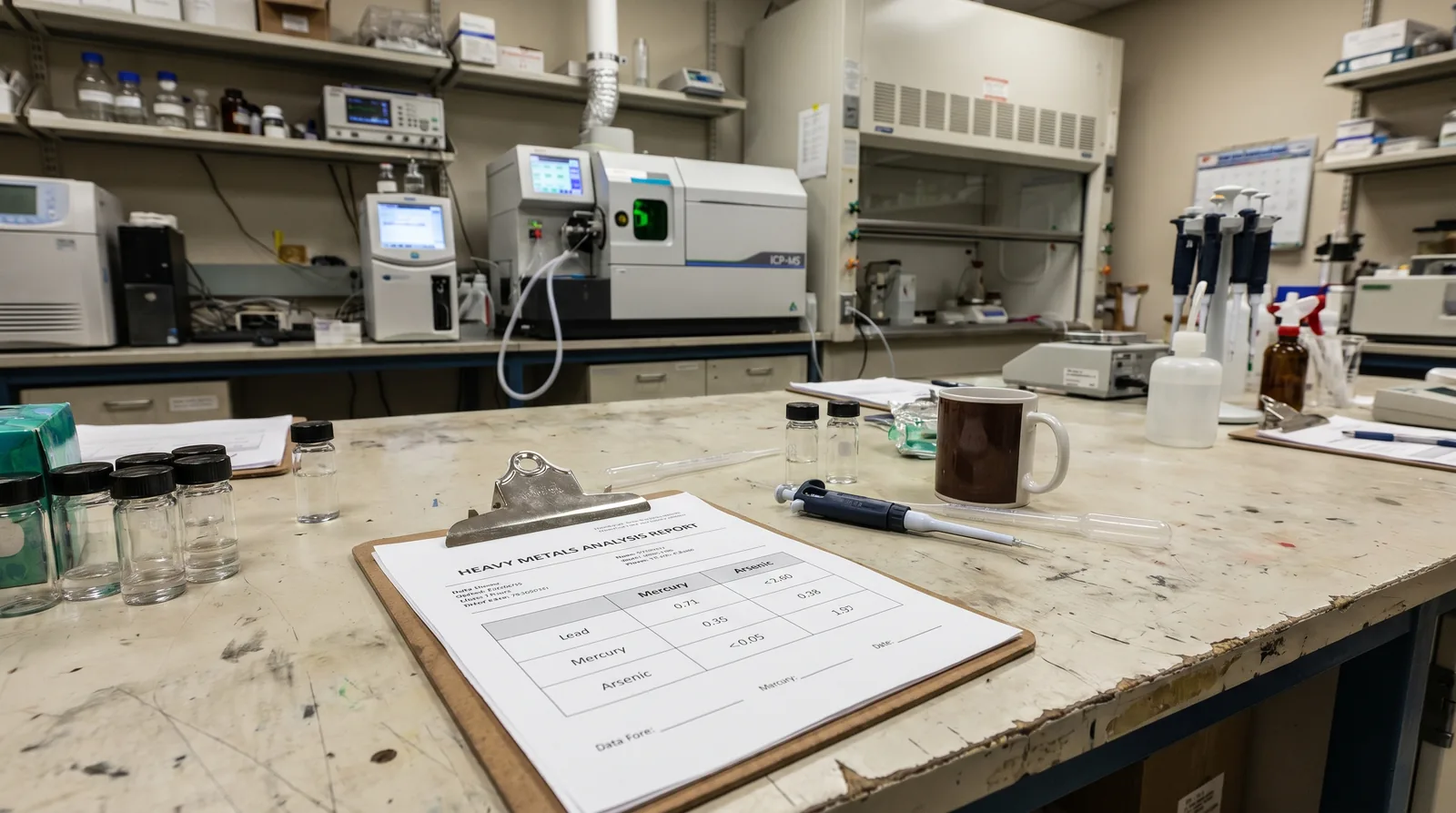
The clearest red flag is a brand that cannot, or will not, show you independent lab results. Heavy-metal content is invisible, tasteless, and not something a label claim can prove. Independent buying guides list third-party testing certification as a key evaluation factor for exactly this reason (Anabolic Health, 2026).
The reason this matters: the supplement industry runs largely on voluntary compliance. A 2025 peer-reviewed analysis of 22 protein powders, using both laser-induced breakdown spectroscopy and ICP-MS to test for 16 elements, found no heavy-metal content above regulatory limits in any sample — yet the authors still recommended mandatory heavy-metal quality-control testing precisely because the industry self-polices (Journal of Nutritional Science, 2025, PMID 40703701). When testing is optional, the brands that test and publish are telling you something the silent ones are not.
What to do: look for a Certificate of Analysis (COA) tied to the lot you are buying, or at minimum to a recent production batch. The values you want to see are arsenic, cadmium, lead, and mercury, each with a measured figure rather than “meets standards.” Any reputable brand should make this available on request.
Chocolate flavoring and high-cadmium categories
Chocolate is the single most consistent flavor-level red flag. In the Clean Label Project’s 2025 Protein Study 2.0, chocolate-flavored powders contained 110 times more cadmium than vanilla varieties, and 65% of chocolate protein powders exceeded California Proposition 65 levels. Cacao plants draw cadmium from soil efficiently, so the flavoring itself is the source.
The same pattern shows up by protein type. The Clean Label Project’s testing, performed by the independent lab Ellipse Analytics using ICP-MS, found plant-based powders contained five times more cadmium than whey-based varieties. Consumer Reports, testing 23 protein powders and shakes published in October 2025, found more than two-thirds contained more lead per serving than its safe daily limit of 0.5 micrograms, with plant-based products averaging nine times the lead of dairy-based powders.
What to do: this is not a reason to abandon plant protein — it is a reason to choose a vanilla or unflavored option and to weight the testing question heavily for any plant powder. The category averages hide enormous variation between individual products, which is why per-product COAs (Solution 1) override category assumptions. If you are weighing trade-offs across categories, our best protein powder guide walks through them without the marketing gloss.
”Organic” and long ingredient lists as false signals
Two labels that read as reassurance can mislead you. First, organic certification governs how the crop was farmed — not the soil’s mineral load. In the same 2025 Protein Study 2.0, certified organic protein powders averaged three times the lead of non-organic products. Organic is not a heavy-metal claim, and the data show it can run the opposite direction.
Second, a long ingredient list makes contamination harder to trace. When a powder blends several plant proteins, gums, flavors, and sweeteners, any one of those inputs can carry the metal load, and you cannot tell which. Fewer ingredients narrow the question. Across the broader set of recurring complaints we cover in common protein problems, traceability is the thread that connects most of them.
What to do: read the ingredient list and the origin, not the front-of-pack adjectives. A single-source protein with a stated raw material is easier to verify than a proprietary blend, regardless of whether either carries an organic seal. If you are choosing for a child with allergies, our allergen-free protein guide covers how single-ingredient products simplify both the allergen and the contamination question at once.
Panic — keep the numbers in proportion
The opposite mistake is overcorrecting. The findings above describe regulatory exceedances, not acute poisoning, and the two are not the same thing. A peer-reviewed human health risk assessment of heavy-metal ingestion among protein-powder consumers concluded that exposure concentrations of arsenic, cadmium, mercury, and lead “do not pose an increased health risk (Hazard Index < 1),” with modeled blood lead levels staying below the CDC guidance threshold of 5 micrograms per deciliter across all scenarios (Bandara, Towle, Monnot, Toxicology Reports, 2020, PMID 33005567).
Proposition 65, which several of the 2025 findings reference, sets thresholds far below the level of demonstrated harm — it is a disclosure standard, not a danger line. The honest reading: heavy-metal exposure from protein powder is a reason to choose carefully and to favor tested products, not a reason to stop using protein powder. The lead source you can most easily control is the one you choose to buy.
What to do: decide based on cumulative daily exposure. If you use protein powder once a day, every day, for years, the case for a verified low-metal product is stronger than for someone using it occasionally. Match the scrutiny to the frequency.
Where single-ingredient potato protein fits
Single-ingredient potato protein isolate addresses two of the red flags above directly: there is only one input to trace, and brands that sell it can publish third-party testing for it specifically. Potato protein is also recognized as a high-quality, allergy-free protein source, and it is a low-FODMAP option for people whose digestion reacts to other powders (Monash University, 2019).
It is not the only sound choice. Whey-based powders averaged the lowest heavy-metal figures in both the Clean Label Project and Consumer Reports testing, so a third-party-tested whey isolate is a reasonable option for anyone without a dairy concern. Single-ingredient protein brands are often cited for single-ingredient powders across categories. The principle is consistent regardless of brand: one verifiable ingredient, current independent testing, and a flavor profile that is not chocolate. If those three boxes are checked, the product is unlikely to be one you should stay away from.