A protein powder with no fillers lists exactly what the front of the tub promises and nothing the back has to apologize for. The phrase “protein powder no fillers” gets used loosely, so it helps to be specific: a filler is any ingredient that is there for texture, taste, shelf life, or volume rather than nutrition — gums, anti-caking agents, sweeteners, flavors, and the occasional cheap amino acid added to inflate a protein number. The shortest possible ingredient list is one item.
An additive-free protein powder lists only the protein source itself — no gums, sweeteners, flavors, or anti-caking agents. The shortest lists belong to single-ingredient isolates such as potato, pea, mung bean, or whey. Single-ingredient powders avoid the sweetener and texture additives that “filler” usually refers to, but every protein powder — plant ones especially — should still be third-party tested for heavy metals, which a short ingredient list does not guarantee.
We evaluated additive-free protein powders by reading every line of the ingredient panel, weighing protein quality against ingredient count, and checking what independent testing has found in each category.
Top Options by Category
Single-Ingredient Potato Protein Isolate
Single ingredient, allergen-free, strong amino acid profile
The ingredient list is one line: potato protein isolate. A potato protein isolate runs roughly 80–95% protein on a dry basis, and the Digestible Indispensable Amino Acid Score (DIAAS) for potato protein isolate has been reported as high as 100% (Food Science & Nutrition, Herreman et al., 2020, PMID:33133540) — a figure that puts it among animal proteins rather than below them. In a clinical trial, women who consumed 25g of potato protein isolate twice daily increased their rate of muscle protein synthesis, while the placebo group did not (Nutrients, 2020, PMID:32349353). It is also low-FODMAP (Monash University, 2019) and free of the top allergens, which is the entire reason a single-ingredient powder exists.
Pros:
- One ingredient — nothing to vet on the back of the label
- No dairy, egg, soy, nut, or gluten
- Low-FODMAP, which matters for IBS-prone digestion
- DIAAS reported as high as 100%; clinically shown to stimulate muscle protein synthesis
Cons:
- Native flavor is earthy; no sweeteners means it tastes like its ingredient
- A smaller research base than whey
- Solubility benefits from a blender rather than a spoon
Unflavored Whey Isolate
Single ingredient, dairy-based, fastest digesting
We will be honest where a category has an edge: for sheer speed of digestion and leucine content, single-ingredient whey is hard to beat. Sold as nothing but whey, it is one line on the panel. Whey raises myofibrillar muscle protein synthesis to about 0.046%/h versus roughly 0.041%/h for a plant blend (J Nutr, PMC11153912, 2024), driven by its higher leucine load. If dairy is not a problem for you and muscle is the priority, a one-ingredient whey is a defensible choice.
Pros:
- Single ingredient, no sweeteners or gums
- Highest leucine of the options here; fast absorption
- The deepest research base of any protein
Cons:
- It is dairy — off the table for milk allergy and most autoimmune-elimination protocols
- Concentrate carries more of the FODMAP lactose than isolate (Monash University FODMAP)
- Animal sourcing some buyers want to avoid
Single-Ingredient Pea Protein
Single ingredient, widely available, high in lysine
Pea protein isolate is the most widely available single-ingredient plant powder — just yellow pea protein, nothing else. Pea is high in lysine — averaging about 7.9 g/100g protein across genotypes (Foods, PMC11547519, 2024). The catch is at the other end of the amino acid profile: the limiting amino acids are methionine plus cysteine, averaging only 2.6 g/100g protein, a chemical score around 46%. That is a real gap, though one ingredient still beats a flavored blend on transparency.
Pros:
- Single ingredient; soy-, dairy-, and gluten-free
- High in lysine; widely stocked
Cons:
- Limiting in methionine and cysteine (chemical score ~46%)
- Pea can contain FODMAPs such as GOS and fructan (Monash University FODMAP)
- Plant powders averaged five times the cadmium of whey in independent testing (Clean Label Project, Protein Study 2.0, 2025)
Single-Ingredient Mung Bean Protein
Single ingredient, high protein density, less-studied
A single-ingredient mung bean protein is among the most protein-dense plant powders by weight, and it makes a genuinely short label — an interesting alternative for households avoiding the usual plant suspects. The trade-off is maturity: mung bean has far less published muscle-synthesis research behind it than whey or potato, so you are buying on the protein number rather than on a body of trials.
Pros:
- Single ingredient; soy-, dairy-, and gluten-free
- High protein density by weight
Cons:
- Limited independent research on muscle outcomes
- Narrower availability than pea or whey
- Plant-source heavy-metal screening still applies
| Pick | Protein source | Ingredients | Top-8 allergens | Protein-quality note |
|---|---|---|---|---|
| Potato protein isolate | Potato | 1 | None | DIAAS reported as high as 100% |
| Unflavored whey isolate | Whey (dairy) | 1 | Milk | Highest leucine; fastest absorption |
| Single-ingredient pea protein | Yellow pea | 1 | None | Limiting Met+Cys (~46% score) |
| Single-ingredient mung bean protein | Mung bean | 1 | None | High density; limited published data |
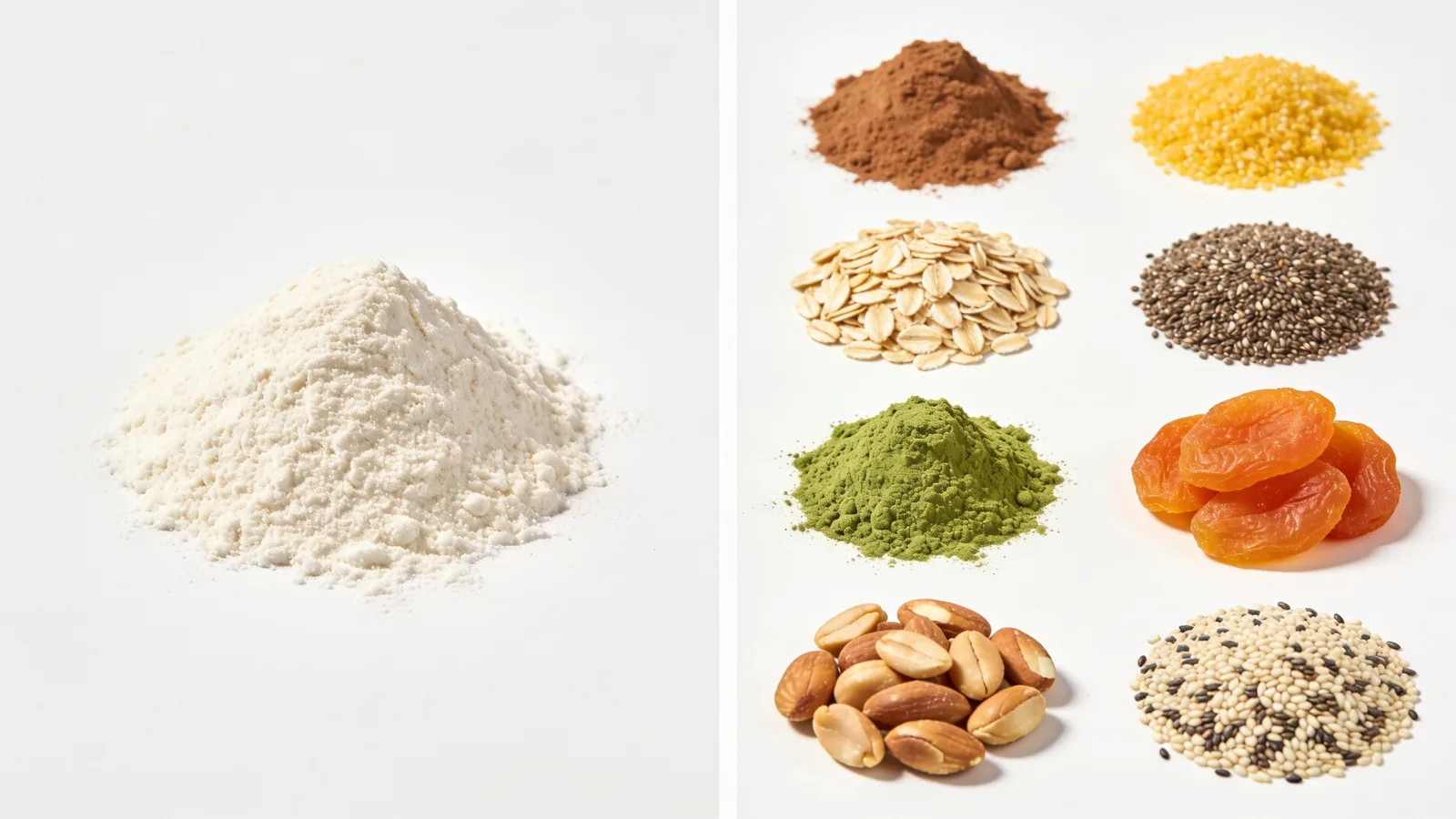
A common point of confusion is the multi-ingredient organic plant blend, which is frequently filed under “additive-free” but is not single-ingredient. These blends typically deliver somewhere around 15–21 g of protein per serving and are often built to be allergen-friendly, but each carries a multi-line ingredient list — usually several pea, rice, and seed proteins plus sweeteners or gums. They can be reasonable formulas, but if your definition of “no fillers” is strict, they sit one tier down from the single-ingredient powders above.
What to Look For on Your Own
Once you stop trusting the front of the tub and start reading the panel, “additive-free” sorts into a few concrete categories. The most common one is digestion and digestive comfort, which is exactly where a short label earns its keep — we cover the broader set of issues in our guide to common protein problems, but the filler question deserves its own look.
Sweeteners and flavors
This is where most “fillers” actually live. Flavored powders carry stevia, sucralose, monk fruit, or a catch-all “flavors” line, plus salt and sometimes cocoa. None of it is harmful in the abstract, but it is also not protein. An unflavored single-ingredient powder removes the entire question — and, for baking, unflavored isolates are recommended precisely so you are not importing extra ingredients into a recipe. The trade-off is taste: a powder with no sweeteners tastes like its ingredient, which is the deal you are signing up for.
Gums, anti-caking agents, and texturizers
Xanthan gum, gum acacia, sunflower lecithin, and silicon dioxide are there to keep powder free-flowing and to thicken the shake. They are functional additives, not nutrition. A single-ingredient powder leaves them out, which is why it may clump slightly more in hot liquids or need a few extra seconds in a blender. That is a texture cost, not a quality cost.
Protein spiking
A subtler “filler” is the addition of cheap free amino acids or nitrogen sources to make a protein content look higher than the intact protein really delivers. The defense is the same as for everything else: a one-line label and third-party verification. For a fuller checklist of what belongs on the panel and what does not, see our notes on what should and shouldn’t be in your protein powder.
Heavy metals — the contaminant a short label won’t fix
This is the part the “additive-free” marketing tends to skip. A unprocessed ingredient list says nothing about what the plant pulled out of the soil. The Clean Label Project’s 2025 Protein Study 2.0 tested 160 products across 35,862 data points and found that 47% exceeded at least one federal or state safety standard, with plant-based powders carrying five times more cadmium than whey-based varieties (Clean Label Project, Protein Study 2.0, 2025). Consumer Reports tested 23 powders and shakes in 2025 and found more than two-thirds exceeded its safe daily lead limit, with plant-based products averaging nine times the lead of dairy-based powders (Consumer Reports, 2025). The lesson is not “avoid plant protein” — it is that a single-ingredient powder still needs a current certificate of analysis. We go deeper in our guide to verifying protein powders for heavy metals.
The protein-quality trade-off
Plant proteins generally score lower than animal proteins on quality metrics, and the usual reason is leucine. A 20g plant blend supplied 1.5g of leucine — half the leucine of an equivalent whey dose — and only when free leucine was added to reach 3.0g did its muscle protein synthesis become statistically indistinguishable from whey (J Nutr, PMC11153912, 2024). Potato is the unusual plant exception here, with a DIAAS reported as high as 100% (Food Science & Nutrition, Herreman et al., 2020, PMID:33133540), which is why it leads this list. If you are weighing plant against whey for muscle specifically, our piece on plant protein versus whey lays out the evidence. For the science of the ingredient itself, see what potato protein is, and for allergen-household planning, the allergen-free protein guide.