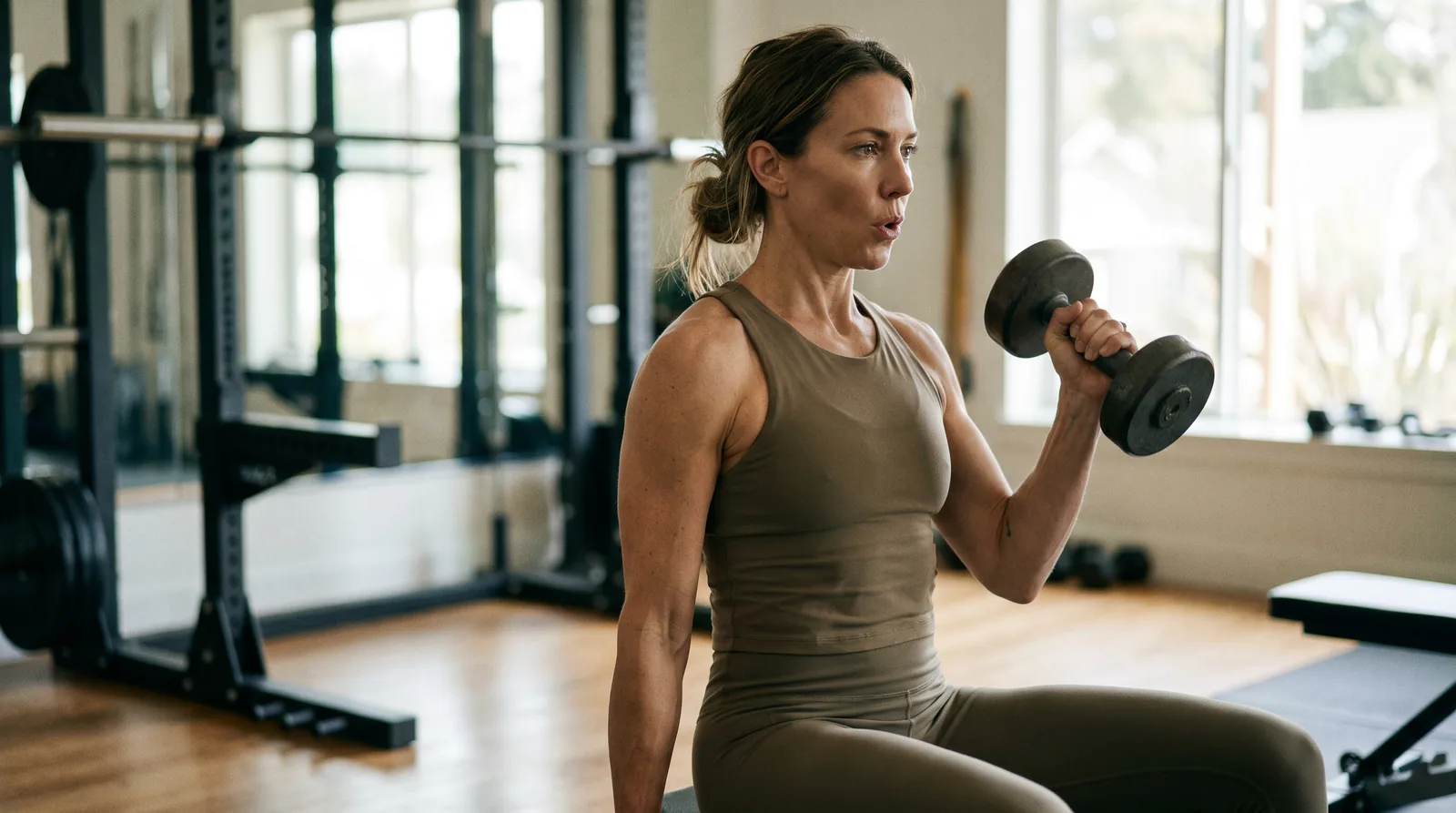
Using protein shakes to build muscle works only when resistance training does the actual building. A shake supplies amino acids — the raw material — but it cannot signal muscle to grow on its own. Muscle hypertrophy requires muscle protein synthesis (MPS) to exceed muscle protein breakdown over time, and the two non-genetic levers that drive that balance are resistance training and protein intake together (Sports Medicine, PMID:24791918).
Protein shakes do not build muscle by themselves. Resistance training is the stimulus that signals growth; protein supplies the amino acids that growth requires. In a 2020 McMaster trial, the exercised leg showed no additional muscle protein synthesis from protein beyond what exercise alone produced — yet at rest, protein still raised synthesis where exercise was absent (Nutrients, PMID:32349353). The practical takeaway: train first, then make sure protein is adequate. Neither input substitutes for the other.
That framing matters because the supplement industry sells the shake as if it were the cause. It is not. The clearest way to think about it: training writes the order, protein fills it. Below is how the two inputs interact, how much the type of shake matters, and where the research draws hard lines.
| Protein source | Typical dose | Leucine per dose | Supports MPS with training? |
|---|---|---|---|
| Whey isolate | 20–30 g | ~3.0 g | Yes — among the strongest responses |
| Plant protein blend (pea-based) | 20 g | ~1.5 g | Yes, but lower than whey unless leucine-fortified |
| Potato protein isolate | 25 g | — | Yes — stimulates MPS at rest and after exercise |
| Collagen | 30 g | ~1.0 g | No meaningful myofibrillar response |
Do Protein Shakes Build Muscle on Their Own?
No. Consuming protein powder alone does not build muscle; it has to be paired with resistance exercise. Without a mechanical stimulus, extra protein is metabolized for energy or excreted, not laid down as new contractile tissue. Protein stimulates synthesis and reduces breakdown, but the signal to grow comes from loading the muscle.
The 2020 potato protein study at McMaster University makes this unusually concrete. Researchers had young women consume potato protein isolate while one leg performed resistance exercise and the other rested. In the exercised leg, there was no additive effect of protein ingestion on muscle protein synthesis rates beyond exercise alone — the training had already maximized the response (Nutrients, PMID:32349353). At rest, the women who consumed potato protein increased their rate of muscle protein synthesis while the placebo group did not. In other words, protein moved the needle most where there was no training to do the work, and training moved it most regardless of the shake.
What Actually Builds Muscle: The Two Required Inputs
Muscle grows when synthesis outpaces breakdown across weeks and months. Resistance training and protein intake are the two primary non-genetic factors that tilt that balance (Science for Sport). Remove either one and hypertrophy stalls.
Training provides the stimulus: acute resistance exercise triggers anabolic signaling — mTOR-pathway phosphorylation measurable within an hour in muscle tissue — that primes the cell to build. Protein provides the substrate: dietary amino acids stimulate MPS, and leucine is the primary amino acid trigger that flips the switch. Insulin from a mixed meal suppresses breakdown on the other side of the ledger. A shake after a session that the body has been loaded for is genuinely useful. A shake on a day with no training, in a person already eating enough protein, mostly tops up a tank that is already full.
If you want the full picture of how training load, dosing, and timing fit together across a week of work, our guide on protein for athletes lays out the programming side in detail.
How Much Does the Type of Shake Matter?
It matters at the margins, not at the foundation. Once total daily protein and a training stimulus are in place, the source determines how quickly and how strongly a single dose raises synthesis — driven mostly by leucine content. Whey leads on speed; plant proteins catch up with adequate dosing or leucine fortification.
The numbers are tighter than marketing suggests. In young adults, 20 g of a plant protein blend raised myofibrillar MPS from a resting baseline of 0.015%/h to 0.041%/h, against whey at 0.046%/h — whey produced about 12.1% more on average (J Nutr, PMC11153912). That plant dose supplied only 1.5 g of leucine, roughly half of whey’s. When researchers added free leucine to bring the plant blend to 3.0 g, its response (0.049%/h) became statistically indistinguishable from whey (J Nutr, PMC11153912). Leucine, not the plant-versus-animal label, was doing the work.
Over a full training block the gap shrinks further. In an 84-day trial of sedentary adults doing weekly resistance training, pea protein and whey produced comparable gains in muscle mass (2.3% vs 2.4%, P = 0.92) and strength, with no significant difference between groups (Nutrients, PMC11243455). Potato protein isolate sits in the same high-quality tier: 25 g twice daily effectively stimulated muscle protein synthesis in young women (Nutrients, PMID:32349353), and the study authors concluded it is a high-quality plant-based protein source. For a closer head-to-head, see whey vs plant protein for muscle growth.
The clear loser is collagen. In a controlled trial, 30 g of whey after resistance exercise significantly raised myofibrillar synthesis (0.041 vs 0.032%/h placebo), while 30 g of collagen (0.036%/h) did not — the rise in plasma leucine and essential amino acids was far smaller after collagen (Med Sci Sports Exerc, PMID:37202878). Even when leucine was matched in a 10-week study, whey out-built collagen for muscle thickness (8.4% vs 5.6%; Int J Sport Nutr Exerc Metab, PMID:35042187). A shake aimed at building muscle needs a complete amino acid profile, not skin-derived protein.
Does the Shake Reduce Soreness or Speed Recovery?
Largely no. A 2022 meta-analysis found protein supplementation had no significant effect on muscle soreness compared with control (European Journal of Clinical Nutrition, PMID:36513777). Post-workout protein drinks have not reliably reduced soreness or sped recovery faster than a carbohydrate drink. The recovery benefit shows up over time, not after a single sore session.
A 2014 systematic review found that beneficial effects, including reduced soreness, become more evident when protein is consumed consistently after daily training sessions rather than as a one-off (PMID:24435468). So the shake’s role in recovery is cumulative: it supports adaptation across a training program by keeping daily protein adequate, not by erasing tomorrow’s soreness. If you train hard and want the mechanics of post-session nutrition, our piece on protein after a workout covers timing and amount.
Why Older Adults Are the Exception Worth Knowing
Aging brings anabolic resistance — a blunted muscle protein synthesis response to a given dose of protein (PMID:23558692). The synthetic response to combined resistance exercise and amino acids is also delayed in older adults compared with the young (Journal of Applied Physiology, PMID:18323467). This is the one population where the shake earns a larger role: the muscle responds less, so the input has to be larger and better-distributed.
Practically, that means older adults often need more protein per meal and across the day to clear the higher threshold, with the ESPEN Expert Group recommending 1.0–1.2 g/kg/day to maintain muscle (Clinical Nutrition, PMID:24814383). A shake is a convenient way to hit that target when appetite or whole-food intake falls short — protein supplements benefit older adults who cannot get enough from food alone (Harvard Health Publishing, 2024). Our guide to anabolic resistance in older adults goes deeper on the dosing math.