Choosing a protein powder for pregnant women comes down to one question that has very little to do with grams of protein: what else is in the tub. A 2025 Clean Label Project study of 160 protein powders found that 47% exceeded at least one federal or state safety standard for heavy metals, and 21% of samples came in at more than twice California Proposition 65 levels. During pregnancy, the ingredient list matters more than the protein claim on the front.
Protein powder is generally considered safe during pregnancy when it contains a single recognized food ingredient and has been third-party tested for heavy metals. The larger risk is contamination and additives, not the protein itself — the Clean Label Project’s 2025 Protein Study 2.0 found 47% of tested powders exceeded at least one safety standard. Confirm any supplement with your OB or midwife before adding it to your routine.
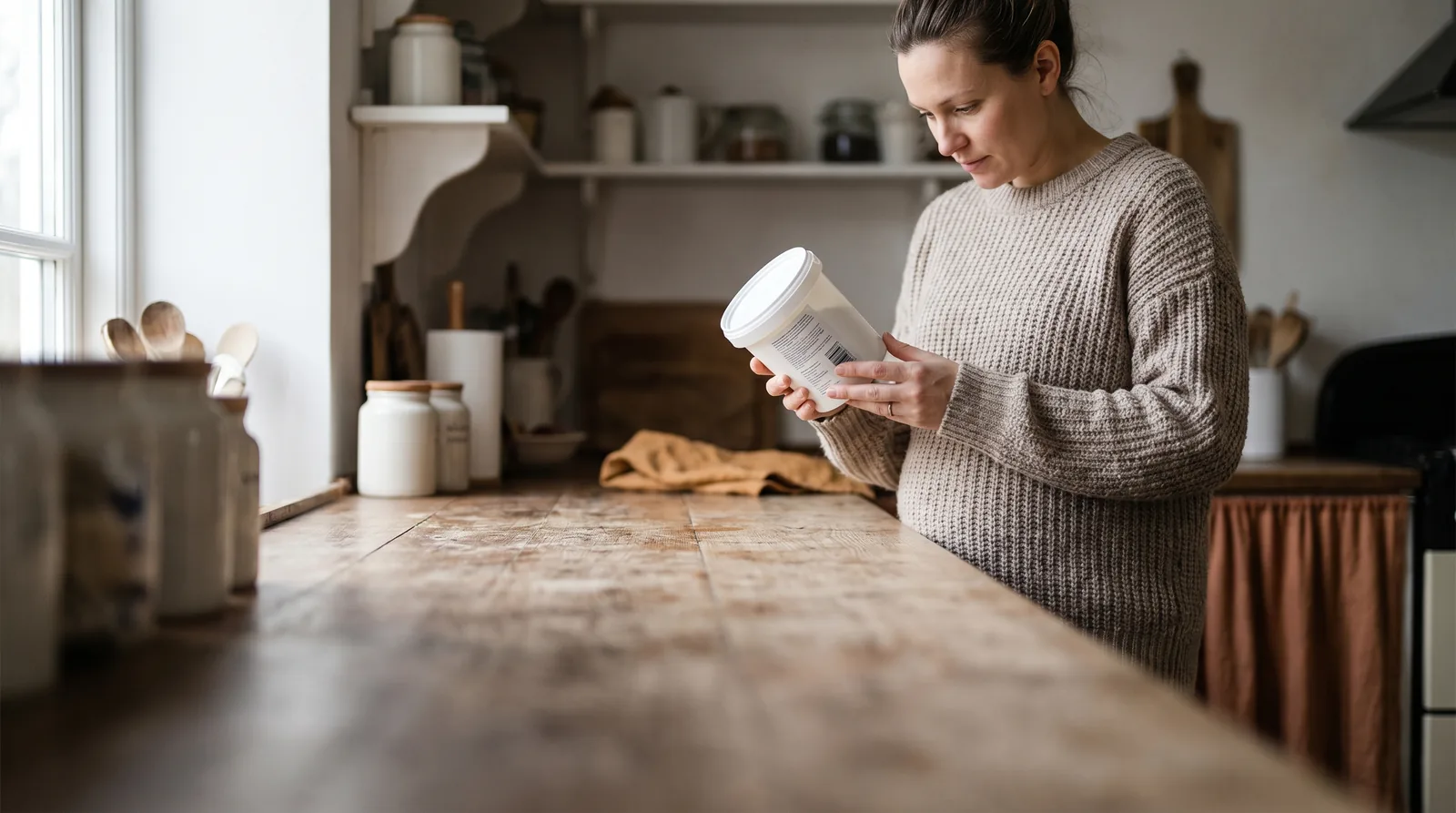
- You turn every tub around to read the back, and the second ingredient is “natural flavors” with no further explanation
- Your appetite has shifted and food sometimes feels like a chore, so a shake is the path of least resistance
- You’ve read enough about heavy metals in supplements to feel uneasy, but not enough to know which products are actually tested
- You want a straight answer, not a brand telling you its blend is “pregnancy-safe” with nothing to back it up
“I don’t need a longer ingredient list. I need to understand every word on the one I already have.”
Protein requirements increase during pregnancy, and many people find that whole-food sources alone are harder to hit when nausea, aversions, or a smaller stomach capacity get in the way. A powder can fill the gap. But pregnancy is also the period when scrutiny of every input is highest — and rightly so. The reasonable goal is not the most protein per scoop. It is the fewest things you have to research, verify, or worry about. That changes how you read a label.
What Makes Protein Harder During Pregnancy
The protein itself is rarely the problem. The complications come from everything bundled around it, and from the fact that pregnancy raises the stakes on contaminants and additives you might have tolerated without a second thought before. Four constraints shape the decision.
Heavy metals concentrate in the products marketed as healthiest
The same 2025 Clean Label Project testing — performed by independent lab Ellipse Analytics using ICP-MS — found plant-based powders contained five times more cadmium than whey-based varieties, and chocolate-flavored powders contained 110 times more cadmium than vanilla, with 65% of chocolate products exceeding Prop 65 levels. Consumer Reports, testing 23 powders and shakes in October 2025, found more than two-thirds carried more lead per serving than its own daily limit of 0.5 micrograms, with plant-based products averaging nine times the lead of dairy-based ones. None of this means plant protein is disqualified — it means flavor, color, and source all change the contaminant picture, and a third-party certificate of analysis is the only way to know where a specific product lands.
Proprietary blends hide what you’re actually consuming
A “blend” listed as a single line with a combined weight tells you nothing about the proportion of each component, the additives folded in, or the sweetener load. During pregnancy, that opacity is the issue. You cannot ask your provider about an ingredient you cannot name. The simplest workaround is a product where the entire ingredient list is one item — there is nothing to decode and nothing buried. We cover why these undisclosed mixes are a problem in our guide to proprietary blends.
Sweeteners and additives become a fresh question
Most protein powders are sweetened, often with stevia, sucralose, or sugar alcohols, plus gums, flavors, and emulsifiers. Many of these are common in the food supply, but pregnancy is exactly when people want to minimize inputs they have not specifically cleared. Stevia-free options exist — an organic plant-based blend can be made stevia-free, with some listing 15g of protein and 0g of sugar per serving, and other stevia-free vegan powders listing 20g — but the cleanest way to sidestep the entire category is a powder with no sweetener at all, because there is no additive to evaluate.
Digestion is already unpredictable
Nausea, reflux, and bloating are common companions to pregnancy, and many protein powders make them worse. Monash University notes that whey concentrate carries more of the FODMAP lactose than isolate, and that pea and soy proteins often retain FODMAPs like GOS and fructan that can trigger gut symptoms. A protein that sits easily matters more when your baseline digestion is already in flux. Potato protein is classified as a low-FODMAP source by Monash University, which makes it a reasonable candidate for a sensitive stomach.
What Actually Works for Pregnant Women
The strategy that holds up under pregnancy-level scrutiny is subtraction, not addition. Pick the product with the shortest, most verifiable ingredient list, confirm it has been tested by a third party, and bring it to your prenatal appointment before you start. Every additive you remove is one fewer thing you have to research at a time when you are already researching everything.
Single-ingredient powders make this easier because there is nothing to interpret. Potato protein isolate is one option here: it is recognized as Generally Recognized As Safe (GRAS) by the FDA, potato allergies are uncommon, and it is free of the top allergens — dairy, egg, soy, nuts, and gluten — which removes another layer of label-reading. That allergen profile is the same reason it suits households managing food sensitivities, which we detail in our allergen-free protein guide. If you want the broader background on the ingredient itself, what potato protein is and how it’s made covers it.
None of this is a substitute for medical guidance. Protein powder is a food, not a prenatal supplement, and it does not replace the vitamins, minerals, and whole foods your provider has you on. Use it to close a protein gap when whole foods are hard to manage, and treat the label as something to verify rather than trust. For the full framework on vetting any product — testing, sourcing, and additives — see our complete protein powder buyer’s guide, and if contamination is your main worry, our breakdown of ingredients to avoid goes deeper.