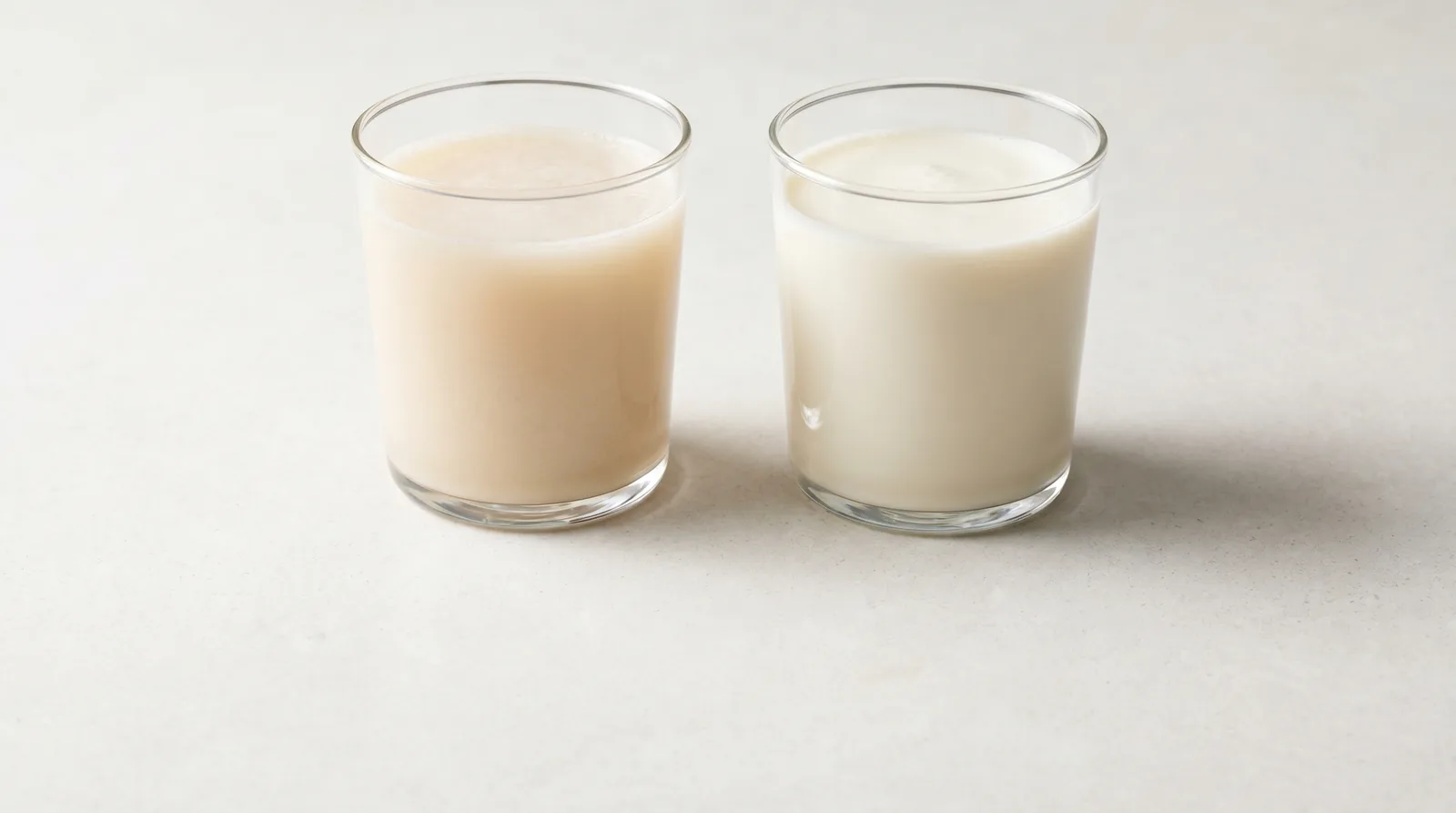
Choosing milk or water for a protein shake comes down to one question: do you want fewer calories or more of them. Water keeps a shake low-calorie and fast-digesting. Milk adds calories, additional complete protein, and a slower release — useful if you are trying to gain, less useful if you are trying to lose. We evaluated both liquids the way you would compare any two ingredients: by calories, digestibility, amino acid contribution, absorption speed, and who each one suits.
For most people, water is the better choice for a protein shake: it adds zero calories, mixes thinner, and lets a complete protein powder do its job without slowing absorption. Choose milk if your goal is weight gain or extra leucine, since dairy adds protein and calories per glass. If you are lactose intolerant or counting calories, use water or an unsweetened plant milk. The protein powder matters more than the liquid.
This is a decision guide, not a product pitch. Below we lay out how we weighed each option, our picks for different goals, and the trade-offs nobody mentions when they tell you to “just use milk.”
Our Picks
Water
Best overall for most people
Water adds zero calories, which is what most people actually want from a shake — the protein, not extra liquid calories. High-protein intake increases satiety and thermogenesis more than standard-protein meals (Journal of the American College of Nutrition, PMID 15466943), and water lets that effect work without adding anything back. It also digests fastest, so a complete protein hits your bloodstream quickly. If your powder is already a complete protein, water gives up almost nothing. This is the default we recommend unless you have a specific reason to do otherwise.
Pros:
- Zero added calories — ideal for weight loss or maintenance
- Fastest digestion and absorption
- No lactose, no dairy allergen
- Mixes thin; nothing to mask the ingredient
Cons:
- Thinner texture; less creamy
- No extra protein or leucine from the liquid
- A chalky powder tastes more chalky in water
Dairy Milk
Best for weight gain or extra leucine
If you are trying to gain weight or struggle to eat enough, milk does real work. It adds its own complete protein — a mix of whey and casein — plus calories and creaminess. The whey fraction is fast-digesting and high in leucine, which stimulates muscle protein synthesis (Journal of Applied Physiology, PMID 19589961). The casein digests slowly, extending the amino acid release over hours (the “slow vs fast” protein distinction; Proc Natl Acad Sci USA, PMID 9405716). For an older adult fighting age-related anabolic resistance, that extra leucine and slower trickle can be useful rather than a liability.
Pros:
- Adds complete protein and leucine per glass
- Adds calories — helpful for gaining or appetite loss
- Creamier texture masks a chalky powder
- Slower digestion extends amino acid availability
Cons:
- Works against a calorie deficit
- Contains lactose — a FODMAP that can cause bloating
- Dairy allergen; off-limits for many households
Soy Milk (unsweetened)
Best plant-based liquid with protein
Among plant milks, soy is the only one that contributes meaningful complete protein. Soy protein isolate reaches the maximum PDCAAS, which the scoring method truncates to 1.00 (J Nutr, PMID 10867064), so unsweetened soy milk adds amino acids the way dairy does without the lactose. The catch: soy is itself a top allergen, and Monash University notes that plant proteins such as soy and pea can be challenging to purify and often carry some FODMAPs. For a dairy-free shaker who tolerates soy, it is the closest plant analog to milk.
Pros:
- Adds complete plant protein (PDCAAS 1.00)
- No lactose
- Creamier than water, lighter than dairy
Cons:
- Soy is a common allergen
- May contain FODMAPs that trigger IBS symptoms
- Flavored versions add sugar — read the label
Almond or Oat Milk (unsweetened)
Lowest-calorie plant option
Almond and unsweetened nut or oat milks give you the creaminess of milk for a fraction of dairy’s calories, but they contribute almost no protein. Treat them as flavored water with body: they improve texture without adding amino acids. Almond milk also introduces a tree-nut allergen, which matters for an allergy household. Choose these when you want a creamier shake but do not need the liquid to add protein — and check that the version you buy is unsweetened.
Pros:
- Creamier than water, low in calories
- Dairy-free and lactose-free
- Wide flavor range
Cons:
- Negligible protein contribution
- Almond varieties add a tree-nut allergen
- Flavored/sweetened versions hide added sugar
What to Look For on Your Own
The liquid is a smaller decision than the powder it carries. Start by matching the liquid to your goal, then work backward to the few details that actually change the outcome.
Match the calories to the goal. If you are in a deficit, water (or an unsweetened plant milk) keeps the shake honest. If you are gaining or recovering appetite, milk is doing useful work, not sabotaging you. This is the single biggest factor, and it is entirely about you, not the chemistry.
Account for your gut. Lactose is a FODMAP, and dairy milk carries more of it than most people assume. Monash University notes that whey concentrate also carries more lactose than isolate because it is less processed. If a shake leaves you bloated, the milk is a more likely culprit than the protein. Potato protein, by contrast, is a low-FODMAP source (Monash FODMAP, 2019), so pairing a low-FODMAP powder with water sidesteps the issue entirely. If bloating, urgency, or nausea is a recurring theme, our guide to common protein problems walks through the usual causes and fixes.
Let the powder’s quality decide whether you need milk’s amino acids. Milk earns its place partly by adding leucine and completing an incomplete powder. But if your powder is already a complete, high-quality protein, that argument largely disappears. Whey isolate is 90–95% protein with under 1% lactose (mindbodygreen, 2023). Potato protein isolate stimulates muscle protein synthesis at rest and after resistance exercise in young women at a 25g dose (Nutrients, PMID 32349353), and its DIAAS has been reported as high as 100% (Food Science & Nutrition, PMID 33133540) — meaning the powder is not leaning on the milk to be complete. Plant proteins do generally start lower in leucine than whey (Current Developments in Nutrition, PMID 38846451), so a lower-quality plant powder is exactly the case where milk or soy milk helps most.
If you are specifically chasing a thin, no-clump shake without dairy, we cover technique in the best protein powder to mix with water. For a weight-loss-first framing, see protein for weight loss.
Quick comparison
| Liquid | Added calories | Protein added | Lactose / allergen | Best for |
|---|---|---|---|---|
| Water | None | None | None | Weight loss, maintenance, fast absorption |
| Dairy milk | High | Complete (whey + casein) | Lactose; dairy allergen | Weight gain, extra leucine, appetite loss |
| Soy milk (unsweetened) | Low–moderate | Complete (PDCAAS 1.00) | No lactose; soy allergen, possible FODMAPs | Dairy-free shakers who tolerate soy |
| Almond / oat milk (unsweetened) | Low | Negligible | No lactose; almond is a tree nut | Creamier texture at low calories |
One more thing the powder decides for you: ingredient transparency. The liquid you add is visible and simple. The powder often is not. The Clean Label Project’s 2025 Protein Study 2.0 tested 160 products and found 47% exceeded at least one federal or state safety standard, with plant-based powders averaging five times more cadmium than whey-based varieties (Clean Label Project, Protein Study 2.0, 2025). No choice of milk fixes a powder you cannot fully read. A single-ingredient powder lets you skip that whole problem — never squint to read your ingredient label.